Your Baby’s First Dental Visit, Step by Step: What Happens From Check-In to Goodbye
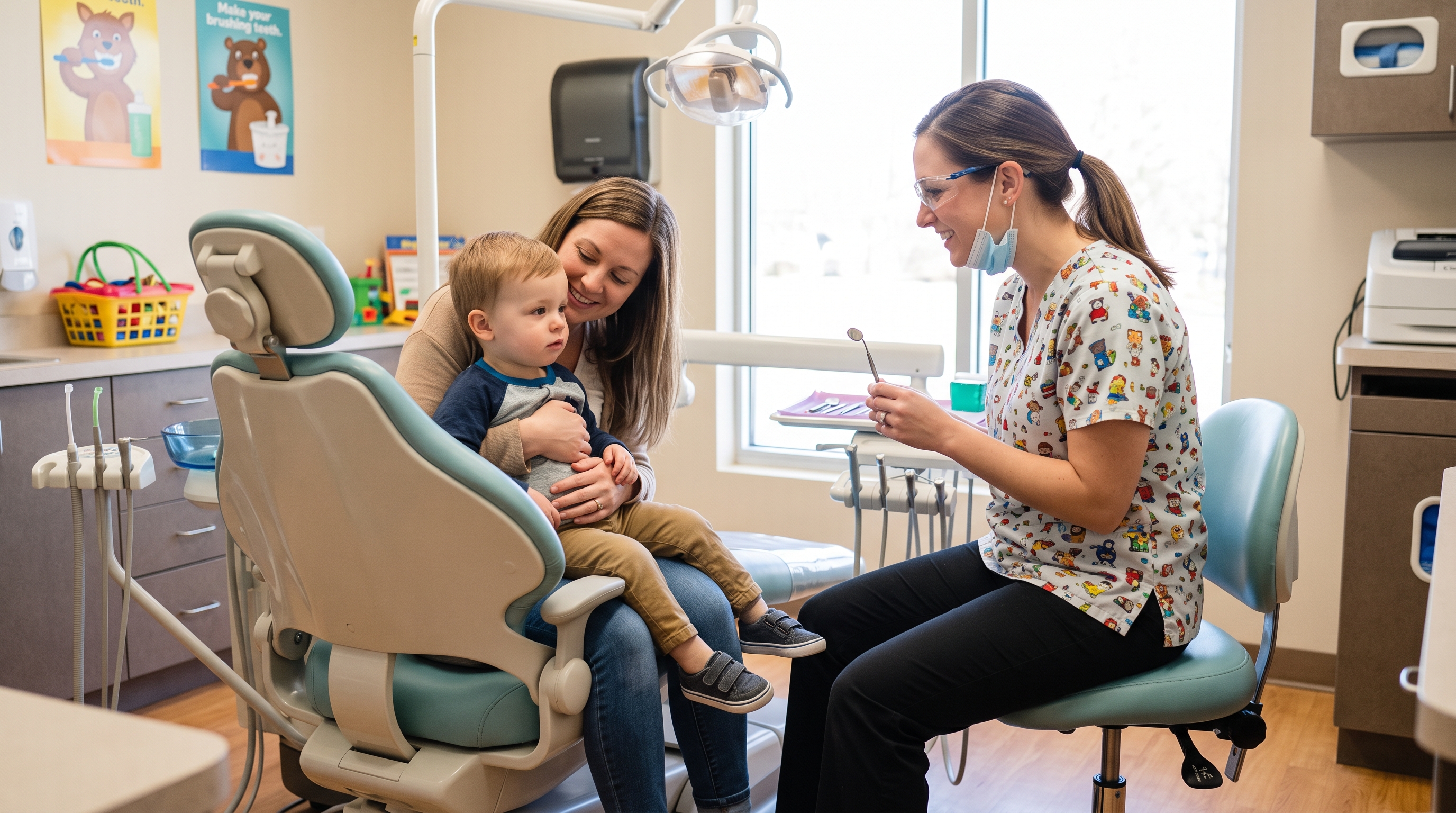
At a baby’s first dental visit, the dentist asks about your child’s health and feeding, checks the teeth, gums and mouth, and explains brushing and diet at home. Dentists usually examine babies on a parent’s lap. The American Academy of Pediatrics advises booking by the first birthday or within six months of the first tooth. JuniorDental offers assessments from birth, so a child with no teeth yet is welcome too.
It is normal to feel nervous before a first visit. You may wonder whether your baby will cry, what the dentist will say about feeding, or what you are meant to do in the room. Below, we walk through the appointment in the order it happens, so you know what to expect.
When should a baby have their first dental visit?
TL; DR: Plan the first visit by your baby’s first birthday, or within six months of the first tooth.
The American Academy of Pediatrics (AAP) advises seeing a dentist by the first birthday or within six months of the first tooth. The American Academy of Pediatric Dentistry (AAPD) sets the same outer limit: a first examination when the first tooth erupts and no later than 12 months of age.
The AAP says first teeth usually appear around six months, but the timing varies widely and some babies have none by their first birthday. A baby without teeth still goes. The dentist checks how the gums and jaws are developing, and you hear the feeding and cleaning advice early.
If your child is already past the first birthday and has not seen a dentist, book the appointment now. The gap does not change the visit. It starts from wherever your child is today, and we will not lecture you about the timing.
What happens before the dentist looks at your baby?
TL; DR: Check-in covers your baby’s health and feeding history, and a well-chosen appointment time makes the rest easier.
A first visit includes a medical history. Expect questions about your baby’s general health, how your baby feeds, and anything about the mouth that has caught your attention.
At JuniorDental, check-in runs on an iPad, and the waiting area has a play zone. We keep waits short and design our spaces for children who find new places hard, children with special needs among them.
Choose a time when your baby has rested. The Texas Department of State Health Services suggests a slot away from nap time, a light meal beforehand and snacks after the appointment.
How does the dentist examine a baby’s mouth?
TL; DR: The dentist usually examines a baby on a parent’s lap and checks the teeth, gums, bite and soft tissues of the mouth.
The Texas Department of State Health Services describes the usual set-up as a knee-to-knee exam. You hold your baby and lean your baby back onto the dentist’s lap, and the dentist looks in. Cleveland Clinic notes that some dentists instead ask a parent to hold the child in the dental chair.
The dentist counts the teeth and looks for white or dark spots, which may signal early decay. The dentist also checks the bite, the gums, the jaw and the other tissues of the mouth, and cleans the teeth when they need it.
The AAPD recommends a caries-risk assessment as soon as the first tooth erupts. In practice, the dentist uses the exam and your answers to estimate how likely cavities are for your child and to decide how frequently to see your child.
Every standard exam at JuniorDental also includes an airway evaluation. We look at jaw width, tongue posture, palate shape and breathing patterns, because a narrow jaw restricts airway space. Babies get the same evaluation, since we assess from birth.
Does a baby need X-rays, a cleaning or fluoride at the first visit?
TL; DR: X-rays are not a routine part of early visits, and a cleaning happens when the teeth call for one.
Cleveland Clinic notes that X-rays are not usually part of early visits. Most children have their first around age 5 or 6, and children at higher risk may need them sooner. The AAPD adds that the timing of a first X-ray should not rest on age. The child’s history, the clinical findings and the risk of oral disease decide.
When your baby needs an X-ray, we use low-radiation digital X-rays, which give 80% less radiation than traditional X-rays.
The dentist will also ask about fluoride. The AAPD schedule calls for a review of fluoride exposure that covers infant formula and fluoride toothpaste, and the AAP recommends fluoride toothpaste from the first tooth.
What will the dentist talk to you about?
TL; DR: Expect advice on feeding, cleaning, pacifiers or thumb sucking, and injury prevention. None of the questions is a test.
The AAPD schedule lists the topics for babies. Oral hygiene starts as a parent’s job. The dentist reviews bottle and breastfeeding practices, discusses whether a baby sucks a thumb or a pacifier, and covers injury prevention, from pacifiers and car seats to play objects and electric cords.
Questions about feeding concern cavity risk, not your choices. The AAPD notes an association between early childhood caries and breastfeeding or bottle use beyond 12 months, especially when frequent or at night. For bedtime, the AAP asks parents to skip the bottle, or to fill it with water only. Children under 2 should avoid added sugar, the AAPD advises, and babies should wait until after 12 months for juice. Every family’s routine looks different, and your answers only shape the advice.
The brushing advice is specific. Before the first tooth, Texas DSHS suggests wiping your baby’s gums after feeds and before bedtime. Once the first tooth appears, the AAP advises brushing at least twice a day with a smear of fluoride toothpaste the size of a grain of rice, then a pea-sized amount from age 3.
Habits get a gentle mention. The AAPD says the oral effects of pacifier use and thumb sucking are of little concern during infancy. It notes research linking infant pacifier use to fewer cases of sudden infant death syndrome. The AAPD does warn that prolonged digit sucking may flare the upper front teeth and may lead to an open bite or a posterior crossbite, so the dentist keeps an eye on the habit as your child grows.
Why do dentists see babies before they have many teeth?
TL; DR: Decay in baby teeth is common in the region, and early visits give families time to prevent it.
A 2017 study of 540 nursery children aged four to six in Ras Al Khaimah found early childhood caries in 74.1% of them. A 2020 meta-analysis of nine countries in the WHO Eastern Mediterranean Region, the UAE among them, put the pooled prevalence of decay in baby teeth at age 5 at 65%, with a wide confidence interval of 45% to 85%.
Neither figure is a verdict on parents. The numbers explain why dentists like to start the conversation about feeding and brushing before problems appear.
What if your baby cries or will not open wide?
TL; DR: Some crying and wriggling is normal for babies, and the lap position keeps you close.
Texas DSHS describes some crying or wiggling as normal during an infant exam. A baby who protests has not failed the visit.
If your baby gets upset, tell the team what usually settles your baby. Texas DSHS advises working with the dentist when a child becomes upset. Our play zones, short waits and sensory-sensitive design exist for children who find new places hard, and they help families with children of every temperament.
How do you prepare for the first visit?
TL; DR: Choose a rested, fed baby, keep your tone positive and write your questions down.
Talk about the dentist in a relaxed, matter-of-fact way. Texas DSHS recommends a positive tone and suggests books or videos about the visit to ease fear.
Write your questions down beforehand. Questions about brushing, teething, pacifiers and night feeds all belong on the list.
What happens after the first visit?
TL; DR: You leave with a home-care plan, and the dentist sets the next check-up date based on your child’s risk.
The AAP notes that the first visit lets the dentist check the teeth and decide how frequently to see your child. The AAPD schedule calls for repeat examinations every six months, or at a different interval when the child’s risk status calls for one. Six months is the usual rhythm, and it matches the check-up guidance we follow at JuniorDental.
Frequently Asked Questions
When should my baby have their first dental visit?
The AAP advises a first dental visit by your baby’s first birthday or within six months of the first tooth. The AAPD recommends the first examination when the first tooth erupts and no later than 12 months of age. If your child is older and has not been yet, book now. The visit starts from where your child is today.
Does my baby need teeth before the first dental visit?
No. The AAP notes that first teeth usually appear around six months, and some babies have none by their first birthday. A baby without teeth still benefits from a visit by 12 months. The dentist checks how the gums and jaws are developing and answers your feeding and cleaning questions. JuniorDental offers assessments from birth.
Will the dentist take X-rays at my baby’s first visit?
Usually not. Cleveland Clinic notes that X-rays are not usually part of early visits. The AAPD says the timing of a first X-ray should rest on the child’s history, clinical findings and risk of disease rather than age. When your baby needs one, JuniorDental uses low-radiation digital X-rays with 80% less radiation than traditional ones.
How long does a baby’s first dental visit take?
The AAP and AAPD guidance does not set a standard length. The time varies with the practice, your baby’s mood and what the dentist needs to cover. Ask the team when you book. The Texas Department of State Health Services suggests choosing a rested time away from nap time. Our short wait times keep time in the waiting area low.
What if my baby cries during the first dental visit?
Some crying is normal. Texas DSHS describes some crying or wiggling as expected during an infant exam, and the exam usually happens on a parent’s lap, so you stay close. Tell the team what usually settles your baby. Our play zones, short waits and sensory-sensitive design help children who find new places hard.
How do I clean my baby’s teeth before the first visit?
Texas DSHS suggests wiping your baby’s gums after feeds and before bedtime. Once the first tooth appears, the AAP advises brushing twice a day with a smear of fluoride toothpaste the size of a grain of rice, then a pea-sized amount from age 3. If a bottle goes to bed, fill it with water only.
Will the dentist judge how I feed my baby or use a pacifier?
No. Dentists ask about feeding and pacifier use because the answers shape the advice. The AAPD says the oral effects of pacifier use and thumb sucking are of little concern during infancy. The conversation is about planning ahead, not about blame. We do not grade a family’s routine.
How frequently should my child see the dentist after the first visit?
The AAPD schedule calls for repeat examinations every six months, or at a different interval based on your child’s risk status. The AAP says the first visit lets the dentist set that schedule. Six months is the usual rhythm, and your dentist will tell you if your child needs a different one.
What should you do next?
If your baby’s first tooth has arrived, or the first birthday is close, book a first visit with a paediatric dentist in Dubai. Bring your questions about feeding, brushing and anything else on your mind. We will examine your child’s mouth gently, explain what we see in plain language and agree a plan with you. The first visit is a conversation as much as an exam, and our team at JuniorDental is glad to answer your questions before you book.